BREED HISTORY
The Bull Terrier originated from crossing Bulldogs with terriers and was standardized by James Hinks in the 1860s, The breed was originally bred as a white-coated “gentleman’s companion” and show dog.
The Bull Terrier – The History, The Legacy
The breed developed from crosses between Bulldogs and the White English Terrier, combining strength, agility, and determination. These early “bull-and-terriers” were valued for their courage, intelligence, and ability to think under pressure.
Following the outlawing of blood sports in 1835, breeders began refining these dogs into a more elegant and companionable form. The most influential figure was James Hinks of Birmingham, England, who, in the 1860s, developed a more refined, all-white dog using the now extinct White English Terrier and later Dalmatian blood.
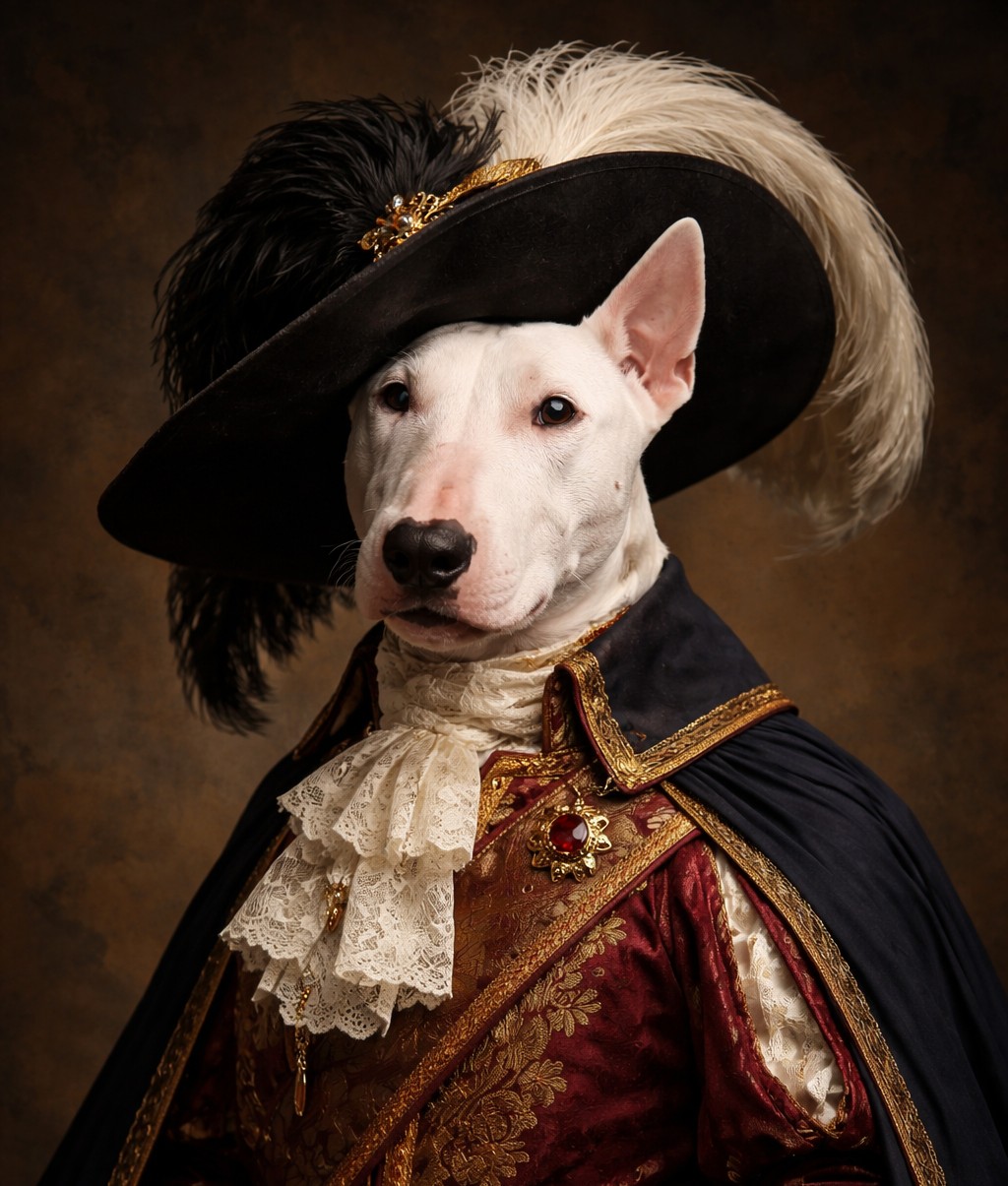
This “White Cavalier” quickly became fashionable and helped establish the breed in the emerging world of dog shows.
Over time, the Bull Terrier continued to evolve. Its distinctive head shape developed in the late 19th and early 20th centuries, while colored Bull Terriers were reintroduced to strengthen health and pigmentation. By the mid-20th century, breeders in the United Kingdom unified white and colored lines, recognizing that both were essential to the breed’s future.
In the United States, the American Kennel Club recognized white and colored Bull Terriers as separate varieties of the same breed in 1942, with both falling under the stewardship of the Bull Terrier Club of America by 1949.
Recognized by the AKC in 1885, the Bull Terrier remains defined by its enduring qualities: courage, intelligence, humor, and deep devotion to people.
Read the expanded version of this article below
A More Expansive History
Origins: Function Before Form
The Bull Terrier emerged in early 19th-century England, developed from crosses between Bulldogs and various Terriers. These “bull-and-terriers” combined strength, tenacity, and endurance with agility, speed, and keen intelligence.
They were not uniform in appearance and came in many colors and sizes. What mattered was performance. As Ernest Eberhard emphasized, these dogs also possessed an unusual ability to think independently and remain steady under pressure—traits that continue to define the breed.
1835: A Turning Point
The outlawing of blood sports in 1835 marked a major shift. With their original purpose gone, these dogs began to be reshaped into more refined companions.
“It is worth noting that Bull Terriers were never common brawlers. They fought because they were bred in a way that made them superb physical specimens and because their owners wanted them to show their prowess. Since this landmark time, their bodies and their high spirits have been maintained at the same high level, but their inclinations have been directed into more peaceful channels”. – Edgar Moss 1945.
During this time of the 1830’s, Victorian society was changing. As Dr. David Harris notes, in his book Bull Terriers Today, the rise of the middle class and the growing popularity of dog shows created demand for dogs that were not only capable, but also stylish and distinctive.
James Hinks and the Birth of the Breed
In the 1860s, James Hinks of Birmingham, England, transformed the bull-and-terrier into a more elegant and recognizable type. By introducing the White English Terrier and later the Dalmatian, he created a cleaner, more balanced dog—longer in head, more refined in outline, and distinctly white. Mr. Hinks grandson, Carlton Hinks, confirmed that “he dipped slightly into the Dalmatian for this breed’s movement, soundness and arched neck”. It has also been suggested that other breeds were used, not necessarily by Hinks, during the development of the Bull Terrier, for example the Spanish Pointer, which may account for the straight tail and the tendency of some Bull Terriers to point. We may never discover the exact “recipe” used.
These dogs became known as Bullterriers (Bull Terrier came in 1935) and their emergence marked the beginning of the modern breed.
Hinks’s dogs, including the famous Puss and Madman, helped establish the breed’s reputation. They were admired not only for their appearance but also for retaining the courage and character of their predecessors.
Growth, Popularity, and Early Influences
By the late 19th century, the Bullterrier had become one of the most fashionable breeds in England. Influential dogs such as Victor, Young Victor, Nelson, and Tarquin helped shape early type and success in the show ring. Dr. David Harris states “these dogs were refined and their Bulldog appearance being further bred out, they were longer and cleaner in head, longer in foreface, free from lippiness and throatiness and necks were longer; they became the old fighting dogs civilized, with all of his rough edges smoothed down without being softened; alert, active, plucky, muscular, and a real gentleman. Naturally, this change brought the Bullterrier admirers, and the milk-white dog became the fashion.”
The breed was recognized by the American Kennel Club in 1885, and the Bull Terrier Club of America was first admitted to AKC in 1895, marking its firm establishment in the United States.
Refinement of Type
The Bull Terrier continued to evolve into the early 20th century. The distinctive head—long, filled, and with its characteristic “downface”—developed gradually and became the breed’s defining feature.
Dr Harris states “the chief architect of the re-fashioned breed was Harry Monk. Raymond Oppenheimer compared Harry’s contribution as ‘the improver of the modern Bull Terrier’ with that of James Hinks as the originator, and afforded Monk ‘the credit of assembling the breed for the first time into a coherent whole’. Born in 1902, Harry’s dog Charlwood, excelled in head and also possessed upright ears. He was sired by a grandson of Tom Gannaway’s first Bull Terrier, Ch. Charlwood Victor Wild (a pivotal dog from whom all modern Bull Terriers are descended).
It is difficult to pinpoint why and exactly when the move towards a downfaced head took root. The first mention appeared in a 1903 critique of Harry’s Charlwood. W. Pegg described him as having a downfaced head, the best of the year. What generated this interest in a downward curvature of the skull and muzzle in a breed requiring a flat head we simply do not know. It was incorporated in a revised Breed Standard in 1915, and has since become the hallmark for the show Bull Terrier.
There were periods when excessive focus on head shape led to a decline in overall soundness. Through careful breeding, balance was restored, reinforcing the Bull Terrier as a complete and athletic dog.
The central challenge—combining the strength of the Bulldog with the refinement and agility of the Terrier—remains a guiding principle for breeders today.
Bull Terrier type is a functional balance of bull and terrier. Tom Horner, in All About the Bull Terrier, described the “essence of Bull Terrier as a well-conditioned athlete, having the greatest degree of substance compacted into the smallest compass without sacrifice of agility.”
Color, Health, and Division
For many years, the all-white Bull Terrier dominated the breed. However, concerns about pigmentation and associated health issues led to the reintroduction of colored dogs in the early 20th century.
This reintroduction created division within the breed community. In the United Kingdom, some breeders resisted the use of colored dogs in white breeding programs, while others embraced them for their genetic benefits.
In the United States, the debate was equally strong. In 1942, the American Kennel Club ruled that white and colored Bull Terriers were not separate breeds, but separate varieties of the same breed. The Bull Terrier Club of America formally accepted responsibility for both in 1949.
Full Circle: Unification of the Breed
By the mid-20th century, the breed reached a turning point.
In the United Kingdom, influential breeders such as Raymond Oppenheimer recognized that continued separation of white and colored lines was detrimental. In 1950, restrictions against using colored dogs in white breeding programs were lifted, allowing breeders to draw from the full genetic strength of the breed.
This marked a return to a unified breeding approach—bringing the Bull Terrier “full circle.”
Key dogs of this period, including Ch. The Knave of Ormandy, Ormandy’s Dancing Time, Ch. Romany Reliance, and Ch. The Sphinx, played important roles in advancing type—particularly head development.
Two later influential sires, Ch. Ormandy Souperlative Snowflash and Ch. Beech House Snow Vision, helped shape the modern Bull Terrier. Today, virtually all Bull Terriers trace back to these foundational lines.
While the United Kingdom and most of the world now treat the Bull Terrier as a single, unified breed regardless of color, the United States continues to maintain separate competition for white and colored varieties, which meet only at the highest levels of competition.
Character: The Enduring Legacy
Despite its complex history, the Bull Terrier has remained remarkably consistent in its essential nature.
As noted by Eberhard and echoed by later writers, the breed’s intelligence, stability, and strong affinity for people set it apart. Its courage and resilience remain, but its role has changed.
Today’s Bull Terrier is known for its personality as much as its appearance—affectionate, humorous, sometimes willful, and deeply devoted to its family. As Dr. Harris aptly described, life with a Bull Terrier is “never a dull moment.”
Key Milestones
Early 1800s: Bull-and-terrier crosses developed
1835: Blood sports outlawed in England
1860s: James Hinks develops the Bull Terrier
1885: Recognized by the American Kennel Club
1895: Bull Terrier Club of America admitted to AKC
1918: Ch. Haymarket Faultless, a white Bull Terrier, was the first to win Best in Show in the United States, at the 1918 Westminster Dog Show
1936: Colored Bull Terrier recognized
1942: AKC designates white and colored as varieties
1950: UK breeders unify white and colored breeding
Further reading:
Edgar Moss, Breeds in Brief, 1946.
The New Complete Bull Terrier, Ernest Eberhard, Howell Books, 1971
All about the Bull Terrier, Tom Horner, Pelham Books, 1973
Bull Terriers Today, Dr. David Harris, 1998